Most people I’ve met share Indiana Jones’s view of snakes: “I hate snakes. . . I hate ‘em.” It seems that Moses, himself, may have shared a similar view of these creatures. Read what he did after God turned his staff into a snake.
The Lord said to him, “What is that in your hand?” He said, “A staff.” And he said, “Throw it on the ground.” So he threw it on the ground, and it became a serpent, and Moses ran from it (Ex 4:2-3).
He “ran from it.” I certainly don’t blame him. However, God brings him back to the snake: “But the Lord said to Moses, ‘Put out your hand and catch it by the tail”—so he put out his hand and caught it, and it became a staff in his hand” (Ex 4:4). For all that Moses will protest in these early chapters, it is remarkable that he doesn’t object more to this command.
This sign was given to him that his fellow Israelites would “believe that the Lord, the God of their fathers, the God of Abraham, the God of Isaac, and the God of Jacob, has appeared to you” (Ex 4:5). Then, in Exodus 7, the Lord has Moses perform this same sign for Pharaoh as a sign that he should let God’s people go (Ex 7:8-13). Pharaoh’s magicians performed the same sign, but “Aaron’s staff swallowed up their staffs” (Ex 7:12).
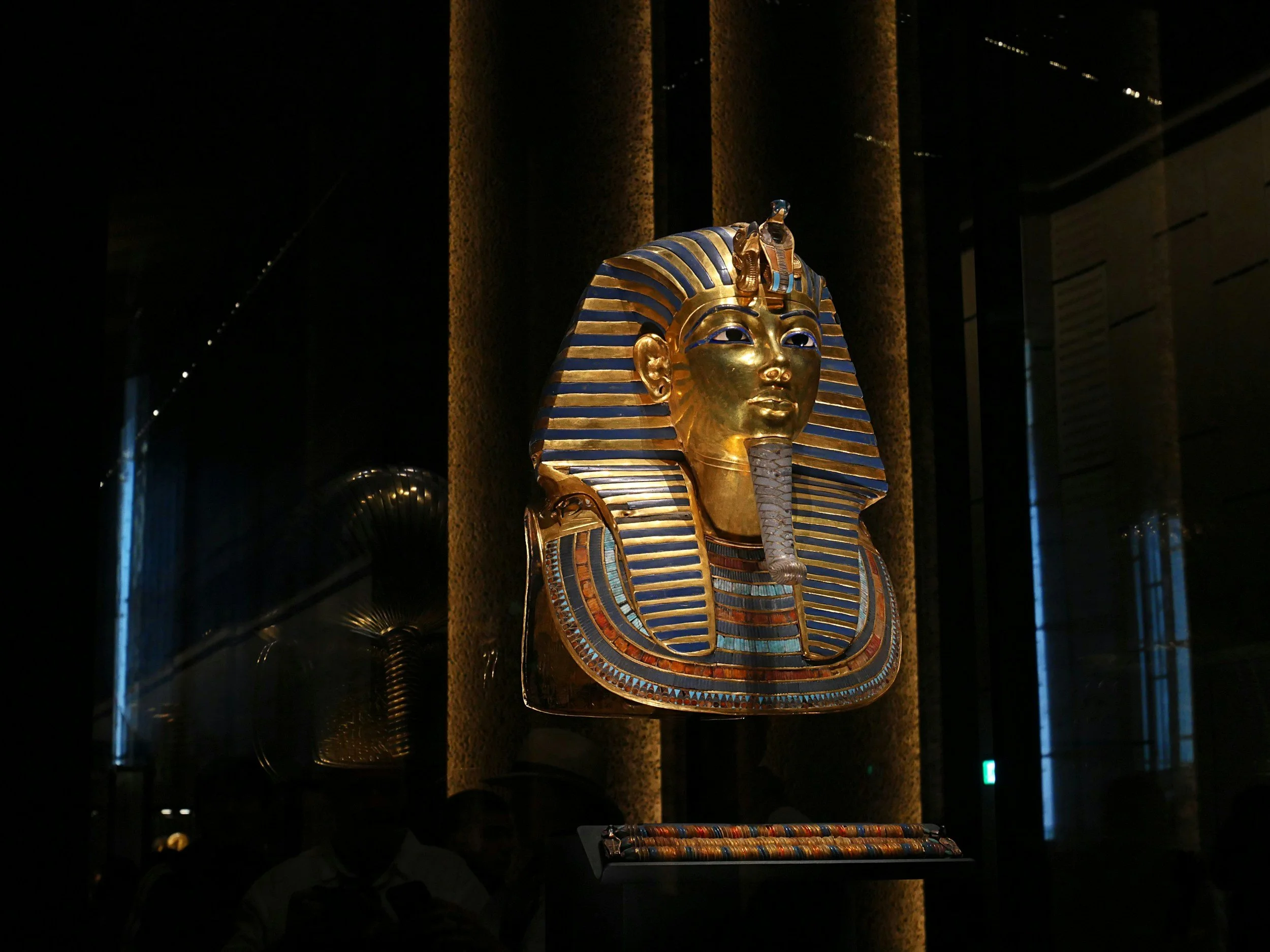
The serpent was a sign of Pharaoh’s power in Egypt. You can think of the mask of Tutankhamun, which features a cobra front and center. Thus, it seems that one of the key reasons for this sign of the staff turning into a serpent was to demonstrate the Lord’s power over Pharaoh. The Lord’s power was even more evident in the serpent from Aaron’s staff swallowing all the other serpents. As the plagues unfold, God’s sovereignty over Pharaoh and the powers of Egypt will be on display. Then, at the Red Sea, God will decisively show that he is in control over Pharaoh and his army. The Lord is the God who has the power to save.
If you’re the least bit familiar with the Bible, you probably know of another infamous serpent—the one in the Garden of Eden who tempted Adam and Even into rebelling against God (Gen 3). Throughout Scripture, the serpent pictures the evil forces arrayed against God and his people, and at points the serpent even pictures Satan himself. The hope of Scripture is that the serpent will not ultimately succeed. As God curses the serpent and expels Adam and Eve from the Garden, he declares, “I will put enmity between you and the woman, and between your offspring and her offspring; he shall bruise your head, and you shall bruise his heel.” There’s hope this serpent will be crushed. The Apostle John picks up on this imagery in the book of Revelation to describe the cosmic conflict between God and Satan. John identifies Satan as “the great dragon. . . that ancient serpent” (Rev 12:9; cf. Rev 20:2), and he looks forward to his final defeat.
With all this negative imagery surrounding serpents, it is surprising to find Jesus comparing himself to a serpent: “And as Moses lifted up the serpent in the wilderness, so must the Son of Man be lifted up, that whoever believes in him may have eternal life” (John 3:14-15). Why would Jesus drawn an analogy between himself and a serpent? We’ll need to look back at this incident with Moses to make sense of it.
As God’s people were wandering in the desert between Egypt and the Promised Land, Moses records:
From Mount Hor they set out by the way to the Red Sea, to go around the land of Edom. And the people became impatient on the way. And the people spoke against God and against Moses, “Why have you brought us up out of Egypt to die in the wilderness? For there is no food and no water, and we loathe this worthless food.” Then the Lord sent fiery serpents among the people, and they bit the people, so that many people of Israel died. And the people came to Moses and said, “We have sinned, for we have spoken against the Lord and against you. Pray to the Lord, that he take away the serpents from us.” So Moses prayed for the people. And the Lord said to Moses, “Make a fiery serpent and set it on a pole, and everyone who is bitten, when he sees it, shall live.” So Moses made a bronze serpent and set it on a pole. And if a serpent bit anyone, he would look at the bronze serpent and live (Num 21:4-9).
God’s judgment for the people’s repeated rebellion was to send poisonous snakes into their camp. The wilderness was not a welcoming place. Moses describes it in Deuteronomy as “the great and terrifying wilderness, with its fiery serpents and scorpions and thirsty ground where there was no water” (Deut 8:15). Here, it became even more terrifying as God sent these serpents into their midst. God’s mercy came, remarkably, in the form of a serpent. Moses crafted a bronze serpent at his command, and “if a serpent bit anyone, he would look at the bronze serpent and live” (Num 21:9). The curse was turned into a sign of God’s mercy.
On the cross, Jesus took the curse we deserve so that we could experience God’s mercy. As Paul explains in Galatians 3:13-14,
Christ redeemed us from the curse of the law by becoming a curse for us—for it is written, “Cursed is everyone who is hanged on a tree”— so that in Christ Jesus the blessing of Abraham might come to the Gentiles, so that we might receive the promised Spirit through faith.
Christ became a curse for us so that we could be blessed. While Moses lifted up the serpent in the wilderness, Jesus was lifted up on the cross. Just as one merely had to look to the bronze serpent to live, so now, one only has to look to Jesus to live. Jesus crushes the serpent’s head (Gen 3:15) by bearing the curse we deserve on the cross. He was lifted up so that we might live.